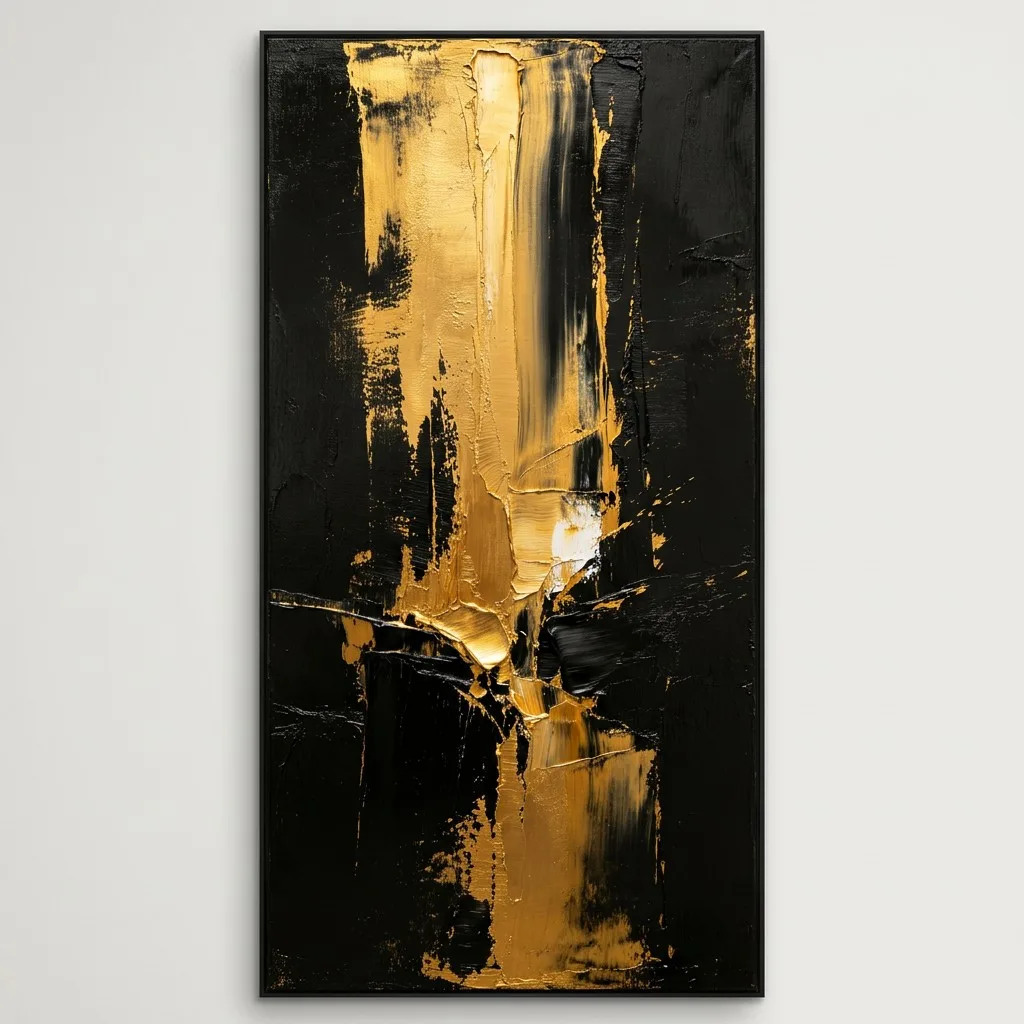
Hotel procurement managers and FF&E consultants ask this question more often than any other when sourcing wall art: should we go with giclée or hand-painted oil?
The answer is rarely one or the other. Most successful hotel art programmes combine both formats — using each where its specific properties create the most value. This guide gives you the numbers and decision framework to choose correctly for each space in your property.
1. What is the actual difference between giclée and oil painting?
Giclée (pronounced "zhee-CLAY") is an archival inkjet printing process. A high-resolution digital image file is printed onto fine art canvas or paper using pigment-based inks — typically EPSON UltraChrome archival inks — at 300 DPI or above. The output is a precision reproduction with consistent, measurable colour accuracy.
Handcrafted oil painting is a manual medium: pigment suspended in linseed or walnut oil, applied by hand onto linen or cotton canvas. Each piece is unique. No two oil paintings produced from the same reference are identical — slight variations in brushwork, texture, and tone are inherent to the medium and, in a hospitality context, are generally considered a feature rather than a defect.
The key technical difference: giclée is a controlled, reproducible process with a measured Delta-E colour accuracy of ≤1.5 across a production batch. Oil painting is a craft process where colour variation between pieces typically falls within ΔE 3–8 — visible to a trained eye at close range.
2. Which lasts longer in a hotel environment?
Both formats are durable in typical hotel conditions, but their failure modes differ.
Giclée durability: UV-resistant archival pigment inks retain colour fidelity at typical indoor light levels (museum-standard testing: 300 lux, 8 hours/day). Hotels with high ambient light exposure near windows should specify UV-filtering glazing or glass for framed giclée pieces. Unprotected giclée prints in rooms with sustained direct sunlight exposure (south-facing windows without UV film) can show measurable fading within 5–10 years; under standard indoor diffused light the colour fidelity is substantially longer.
Oil painting durability: High-quality oil paintings on linen canvas hold their surface for multiple generations under controlled conditions. In hotel environments, the primary risks are humidity fluctuation (causing canvas expansion and contraction, leading to cracking at 30–70% relative humidity swings) and UV exposure (causing pigment fading over 15–25 years without UV protection).
Practical takeaway: For standard hotel guest rooms, where art is typically replaced every 7–10 years as part of a renovation cycle, both formats comfortably outlast the replacement window. For signature pieces in permanent public spaces — lobbies, boardrooms, executive floors — the long-term durability of oil painting on linen canvas is a meaningful advantage.
3. What does each cost for a 200-room hotel project?
This is the question that drives most procurement decisions. The numbers vary by size, complexity, and substrate, but typical ranges for hotel-quality work from a factory-direct supplier are:
Giclée canvas prints (including frame):
- Standard guest room size (60x80cm – 80x100cm): $15–45 per piece
- Feature wall or suite size (100x140cm – 150x200cm): $40–120 per piece
- Large-format lobby (200cm and above): $80–220 per piece
Handcrafted oil paintings (including frame):
- Standard guest room size (60x80cm – 80x100cm): $50–120 per piece
- Feature wall or suite size (100x140cm – 150x200cm): $120–280 per piece
- Large-format lobby (200cm and above): $200–500 per piece
For a 200-room hotel with 2 artworks per room, a typical procurement scenario:
- Giclée only: 400 pieces × $25 average = approximately $10,000
- Oil only: 400 pieces × $80 average = approximately $32,000
- Mixed (giclée for rooms, oil for public spaces): 320 giclée × $25 + 80 oil × $150 = approximately $20,000
The mixed strategy delivers a meaningful cost saving while allocating the higher-impact handcrafted medium where guests spend the most time looking.
For California-bound projects, confirm that your supplier can provide CARB Phase 2 documentation — see our CARB compliance guide.
For a real-world example of how format choice, palette, and two-series structure play out in a boutique resort project, see our Yunnan mountain resort case study.
For a broader discussion of when factory direct sourcing makes economic sense versus buying through art distributors, see our factory direct vs distributor guide.
4. How consistent is colour across 200+ identical pieces?
This is where giclée and oil painting diverge most sharply.
Giclée colour consistency: Each piece is printed from the same calibrated file on the same substrate, using the same ink profile. We measure Delta-E across production batches; our standard tolerance is ΔE ≤1.5. At ΔE ≤1.5, colour differences are imperceptible to the unaided eye at normal viewing distance. We provide Delta-E batch reports on request for orders above 30 pieces.
Oil painting colour consistency: Hand-painted pieces from the same reference will vary. Typical variation is ΔE 3–8 between individual pieces, which is perceptible at close range — 1 metre or less. At normal hotel room viewing distance (2–3 metres), most guests will not notice the variation. For corridors where 10 or more identical pieces hang in sequence at close intervals, the cumulative variation becomes visible.
ΔE reference guide:
- ΔE 0–1: Imperceptible difference
- ΔE 1–2: Barely perceptible by a trained observer
- ΔE 2–3.5: Perceptible on close inspection
- ΔE 3.5+: Clearly perceptible
For hotel projects specifying consistency across multiple spaces, giclée with Delta-E QC documentation is the appropriate choice. For rooms where each piece is viewed in isolation, the variation in oil painting reads as authenticity rather than inconsistency.
5. Which is better for lobby feature walls versus standard guest rooms?
The decision framework is straightforward:
Lobby, restaurant, spa reception, executive lounge:
- Guests dwell here, look closely, and form their first impression of the property
- High ceilings and large wall surfaces suit large-format works (180x240cm and above)
- Handcrafted oil painting or 3D impasto textured pieces deliver visual weight and material presence that giclée cannot replicate at this scale
- Feature walls with impasto texture add tactile dimension visible from 5–10 metres
Standard guest rooms:
- Art is typically viewed from 2–3 metres, from the bed or seating area
- Consistent presentation across 150–300 identical rooms matters to brand standards
- Giclée with Delta-E ≤1.5 batch tolerance achieves this reliably
- Cost efficiency allows for more pieces per room and higher-quality frames
Suites and premium rooms (15–30% of inventory):
- Budget allows for hand-painted work
- Guests in premium categories notice and value handcraft
- Typical suite art budget: 3–5× standard room allocation
Corridor and service areas: High-volume, low-viewing-attention environment. Giclée is appropriate; invest the budget saving in public areas.
6. What are the lead time differences?
Lead times are one of the most important procurement variables, particularly for hotels on a fixed opening schedule.
Giclée canvas prints: 15–25 working days from approved digital file to FOB Xiamen, for orders up to 500 pieces. Above 500 pieces, add 5–7 working days per additional 200 pieces.
Handcrafted oil paintings: 20–35 working days from approved reference to FOB Xiamen, for orders up to 100 pieces. Above 100 pieces, the production window extends to 35–50 working days as each piece is painted individually.
Mixed orders (typical 200-room hotel): When both formats are combined in one project, the critical path is the oil painting component. A mixed order of 320 giclée + 80 oil typically requires 40–50 working days to FOB Xiamen, as the oil painting schedule controls the shipping date.
Sample production: Giclée samples: 5–7 working days. Oil painting samples: 10–15 working days. Both formats allow sample approval before full production begins.
7. Which is easier to transport and install without damage?
Giclée: Lightweight (a 80x100cm framed giclée typically weighs 2–4 kg). Standard export carton packing is sufficient for most sizes. Pieces up to 150cm can be packed in multi-layer corrugated cartons with corner protectors.
Oil painting: Heavier (a 80x100cm framed oil painting on canvas with a wood stretcher typically weighs 4–8 kg). Large pieces (above 150cm) require individual wooden crates for safe transit. Crate cost adds $15–40 per piece for large-format work.
Installation hardware: Both formats require secure wall fixings for fire code compliance. In the US, wall fixtures above 2 kg typically require fixed anchors rather than adhesive strips (specific requirements vary by jurisdiction — confirm with your local contractor and fire marshal). We provide hanging hardware specifications and installation guides; installation itself is the responsibility of the buyer's local contractor.
Transit damage risk: Oil paintings on canvas are more susceptible to surface damage from impact or moisture in transit than framed giclée. We photograph every oil painting before packing and share the image set with the buyer for pre-shipment approval. If damage occurs in transit and the buyer provides photographic evidence at delivery, we replace the affected pieces in the next production slot (15–20 working days for replacements).
8. Can you mix giclée and oil painting in one shipment?
Yes, and this is one of the most common strategies for hotel projects. A typical mixed shipment for a 200-room property might be structured as:
- 320 giclée pieces for standard rooms (80% of inventory)
- 60 oil paintings for suites and premium rooms (15%)
- 20 large-format oil or impasto textured pieces for lobby and public areas (5%)
All three categories ship FOB Xiamen in a single consolidated shipment. We coordinate packing so giclée cartons and oil painting crates are segregated in the container for easier site distribution on arrival.
Typical mixed order ratio in our hotel projects: giclée 60–75% by piece count, oil painting 25–40% by piece count, oil painting 55–65% by value. The mix varies by property tier and brand positioning.
9. What does the hotel guest actually notice?
This is the question that reframes the entire procurement decision. Research on hotel guest experience consistently shows that:
- Guests in standard rooms spend an average of 15–30 seconds looking at wall art after check-in, primarily from 2–3 metres
- In lobbies, guests spend more time but less focused attention — the art registers as part of an overall environmental impression rather than as individual pieces
- In F&B and spa environments, art dwell time is highest — guests seated for 30–90 minutes have extended exposure
The practical implication: at 2–3 metres and 15 seconds, giclée with high-quality printing and appropriate frame selection is indistinguishable from hand-painted work to most guests. At arm's length (lobby artwork, corridor pieces viewed while walking past), visual texture — the quality that impasto and hand-painted surfaces provide — becomes perceptible.
This supports the mixed strategy: invest in handcrafted pieces where guests spend extended time at close range (lobby, restaurant, spa), and use giclée where cost efficiency and consistency matter more (guest rooms, corridors, back-of-house).
10. FAQ — Giclée vs Oil Painting
Q: Is giclée considered fine art for hotel procurement specifications?
A: Giclée is archival print-making, classified as a reproduction medium. For spec-writing purposes, specify substrate (fine art canvas, minimum 380gsm), ink type (archival pigment, minimum 8-colour gamut), and colour warranty period (industry testing at 300 lux, 8 hours/day; confirm specific warranty terms in supplier contract).
Q: What DPI should I specify for hotel giclée prints?
A: 300 DPI minimum at final output size. Files submitted below 300 DPI at the required output dimensions will be upsampled — always request a full-size supplier proof before approving production.
Q: How many original oil painting compositions do I need for a 200-room hotel?
A: Typically 3–6 original compositions, reproduced in 30–80 copies each depending on the number of room categories. Variation between hand-painted copies is inherent to the medium and does not require individual approval for each piece.
Q: How do I specify colour tolerance for oil paintings in an RFQ?
A: Use photographic reference approval ("client approves pre-shipment photographs") rather than Delta-E targets. Delta-E measurement is not applicable to unique handcrafted pieces. For giclée, specify Delta-E ≤2 as the batch tolerance standard.
Q: What frame weight should I specify for fire code compliance in US hotel guest rooms?
A: Requirements vary by jurisdiction. Most US fire codes require wall fixtures above 2 kg to use fixed anchors rated to 3× the fixture weight. Specify frame weight in the RFQ and request hanging hardware specifications and installation drawings from the supplier; final fire code interpretation is the responsibility of the property's local contractor and AHJ.
Q: Can giclée and oil paintings be produced from the same artwork file?
A: Yes. Providing a high-resolution digital file (minimum 300 DPI at output size) allows both giclée prints and hand-painted oil reproductions to be produced from a single source, ensuring tonal consistency between the two formats within the same project.
Which to choose — a simple decision matrix
| Factor | Giclée | Oil Painting |
|---|---|---|
| Colour consistency across 200+ pieces | ΔE ≤1.5 | ΔE 3–8 |
| Cost per piece (standard room size) | $15–45 | $50–120 |
| Lead time (100 pieces) | 15–25 days | 20–35 days |
| Weight (80x100cm framed) | 2–4 kg | 4–8 kg |
| Visual texture at close range | Flat | Present |
| Colour warranty character | Archival pigment ink | Traditional oil medium |
| Appropriate for 300+ identical rooms | Yes | Challenging |
| Appropriate for signature lobby piece | Limited | Yes |
Request a Giclée vs Oil Painting Sample Comparison
If you are preparing an RFQ for a hospitality project and want to compare both formats on the same reference image, we can send a matched pair (one giclée + one hand-painted oil in the same subject) for on-site evaluation.
Contact: sales@qitong-arts.com
Response time: within one business day
Trade Assurance: available on Alibaba for all orders
Request Sample Comparison → Hospitality Project References →