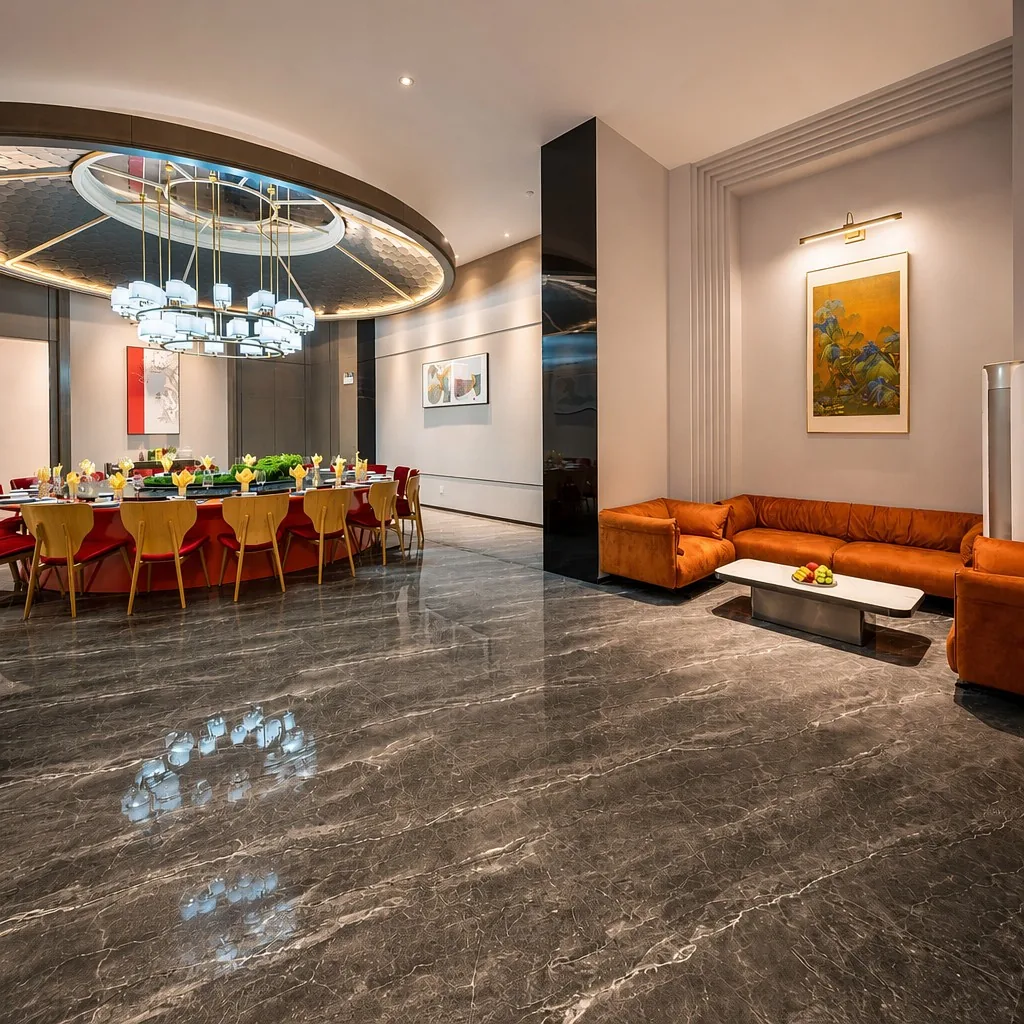
Healthcare interior design serves a fundamentally different brief than hotel or residential work. The patient, resident, or visitor experience is shaped by an environment with very specific constraints: infection control, material safety, maintenance, and the documented relationship between the visual environment and patient outcomes.
Wall art in a clinical setting is not decoration. It is part of the environment of care. This guide covers what procurement managers, interior designers, and facilities teams need to know when sourcing wall art for hospitals, outpatient clinics, senior living communities, and long-term care facilities.
All material compliance data referenced in this guide reflects testing results available from Qitong Arts — Bureau Veritas certification for surface materials and SGS CARB Phase 2 testing for MDF-based substrates. We do not reference compliance standards we cannot document.
1. Why does wall art compliance matter in healthcare environments?
Healthcare facilities in the United States and most OECD countries are subject to occupational health and environmental standards that do not apply to commercial or residential spaces. Three categories of regulation are most relevant to wall art procurement:
Indoor air quality (IAQ). Materials that off-gas volatile organic compounds (VOCs) or formaldehyde in an enclosed clinical space directly affect air quality for patients who may be immunocompromised, chemically sensitive, or spending extended periods (days or weeks) in a single room. The off-gassing rate of formaldehyde from MDF-backed artwork, for example, depends on temperature, humidity, and ventilation — all of which are actively controlled in clinical settings.
Surface cleanability. Healthcare facilities follow infection prevention and control (IPC) protocols that require surfaces — including wall art frames and print substrates — to be wipeable with standard clinical disinfectants. Porous or unsealed surfaces cannot be adequately cleaned and are typically excluded from procurement specifications.
Heavy metals and restricted substances. Inks, coatings, and surface treatments used in decorative products are subject to restricted substance limits under US CPSC regulations, California Proposition 65, and EU RoHS. For healthcare settings serving paediatric patients, these limits are particularly important.
2. What VOC and toxicity standards apply to hospital wall art?
The primary standards relevant to hospital wall art in North America are:
CARB Phase 2 (California Composite Wood Products Regulation). Limits formaldehyde emissions from MDF, particleboard, and hardwood plywood used in finished goods. For MDF — the most common backing and framing material in wall art — the limit is 0.11 ppm (standard panels) or 0.09 ppm (particleboard). Our SGS-tested MDF framing materials have a measured emission value of 0.08 ppm, below the CARB Phase 2 threshold.
For a full walkthrough of CARB Phase 2 compliance mechanics, test reports, and importer risk exposure, see our CARB compliance guide.
US EPA TSCA Title VI. As of 2024, CARB Phase 2 limits apply nationally across the United States, not only in California. All regulated composite wood products sold in the US must meet these limits.
VOC content of inks and coatings. The inks used in giclée production (EPSON archival pigment inks) are solvent-free and VOC-free. Standard oil-based topcoats applied to oil paintings may contain trace VOCs; our healthcare-specification oil paintings use water-based protective coatings that comply with EPA Method 24 low-VOC requirements.
Heavy metals in pigments and surface coatings. Bureau Veritas testing of our canvas and surface materials confirms compliance with the applicable heavy metals and phthalate limits under US CPSC (16 CFR Part 1303) and EU EN 71-3, covering Total Lead, Total Cadmium, and phthalate content.
The Bureau Veritas certificate and specific numerical test results are available in documentation form for procurement review on request.
3. What certifications should you request from a supplier?
For a healthcare wall art procurement specification, the following documentation provides the strongest compliance evidence:
CARB Phase 2 test report. A third-party laboratory test report (ASTM E1333 or ASTM D6007 method) showing formaldehyde emission from the finished product or from the MDF substrate used in production. Valid for 3 years from test date. Our current SGS test report is available on request.
Bureau Veritas material certification. Surface material testing for heavy metals (Lead, Cadmium, Chromium VI) and restricted substances (phthalates, azo dyes). This covers the canvas, coating, and frame surface materials — not the substrate — and confirms compliance with US CPSC and EU EN 71-3 limits. Our BV certificate covers the canvas and surface coating materials used in giclée production.
VOC-free ink certification. A statement from the ink manufacturer confirming zero VOC content. EPSON UltraChrome archival inks, which we use for giclée production, are water-based pigment inks without organic solvents.
What to avoid: A supplier certificate of compliance (a self-declaration) without an underlying third-party test report is not adequate for healthcare procurement. Ask specifically for the laboratory name, test date, and report reference number on any compliance documentation.
4. Are canvas prints or oil paintings better for patient-facing spaces?
Both formats can be appropriate for healthcare environments, with different strengths in different settings.
Giclée canvas prints are the more practical choice for high-volume healthcare procurement. They can be produced in identical batches with Delta-E ≤1.5 colour tolerance across 100–500 pieces, providing consistent presentation across wards and corridors. The printing substrate — EPSON archival pigment on cotton or linen canvas — is VOC-free and can be sealed with a water-based matte or satin topcoat to achieve a wipeable surface.
Typical giclée canvas lead time for a healthcare order: 15–25 working days for 50–200 pieces.
Handcrafted oil paintings are most appropriate for waiting areas, reception lobbies, chapels, and palliative care suites — spaces where patients and family members spend extended time and where the tactile presence of handcrafted work contributes to the quality of the environment. Oil paintings require a water-based protective varnish for clinical wipeability; standard oil varnishes are not appropriate for infection-controlled environments.
Typical oil painting lead time for a healthcare order: 25–40 working days for 20–50 pieces.
For a full side-by-side comparison of giclée vs oil painting formats, cost, and guest perception at hotel viewing distances, see our giclée vs oil painting comparison — the format tradeoffs translate directly to healthcare planning.
5. What colour palettes support patient wellbeing in clinical spaces?
The relationship between colour and patient wellbeing is documented in healthcare interior design research, but we note that specific clinical outcomes from colour choices are beyond the scope of what an art supplier can certify. What we can offer is practical guidance on what experienced healthcare designers typically specify.
Soft greens and sage tones. Widely used in oncology, recovery, and rehabilitation environments. The association with natural outdoor settings is well-established in restorative environment design.
Warm whites and warm neutrals. Preferred in paediatric settings. Avoid pure white (too clinical) and primary colours (too stimulating for acute care).
Pale blues and aqua tones. Common in cardiac and respiratory care environments. Blue tones are associated with reduced stress response in multiple studies of environmental psychology.
Avoidance in most patient-facing spaces: high-contrast geometric patterns, intense reds and oranges, and pure black and white combinations, which can be disorienting for patients with cognitive impairment or altered perception.
For subject matter: nature scenes (landscapes, botanical, water), abstracted natural forms, and non-representational soft-field paintings are standard in clinical settings. Figurative art with human faces requires care — appropriate in some contexts, potentially distressing in others.
We produce custom colour-matched artwork to a designer's palette specification. Provide a Pantone or RAL reference and we will match to Delta-E ≤2 on the final substrate.
6. How do anti-glare and wipe-clean surfaces work for clinical environments?
Two surface properties matter most for clinical wall art:
Anti-glare finish. Overhead fluorescent or LED lighting in clinical settings creates significant glare on glossy print surfaces. Standard giclée canvas with a matte or satin finish has a natural low-glare surface; framed giclée under glass requires anti-reflective (AR) glass, not standard float glass. We can supply AR glass framing for clinical specifications; the cost premium over standard glass is approximately $8–15 per piece for standard sizes.
Wipe-clean surface. A sealed canvas surface (water-based matte varnish, 2–3 coats) can be cleaned with a damp cloth and standard quaternary ammonium disinfectants (the most common clinical surface disinfectant class). Standard unvarnished canvas is not wipeable and should not be specified for patient rooms or high-touch areas.
We apply a wipeable clinical varnish as a standard option on healthcare orders. This is specified at the order stage — it cannot be added after production. The varnish does not affect colour or Delta-E readings but slightly increases frame depth by 1–2mm.
7. What are lead times for a multi-floor healthcare project?
Healthcare construction and renovation schedules are often fixed by infection control requirements — art installation typically occurs in a narrow window after final cleaning and before patient or resident occupancy.
Lead time benchmarks for Qitong Arts healthcare orders:
- 50–100 pieces, giclée with frames: 20–28 working days, FOB Xiamen
- 100–300 pieces, giclée with frames: 28–40 working days, FOB Xiamen
- 20–50 pieces, handcrafted oil painting: 28–40 working days, FOB Xiamen
- Mixed format (giclée + oil), 150–250 pieces: 35–45 working days, FOB Xiamen
Add sea freight time: approximately 15–20 days Xiamen to US West Coast ports, 20–25 days to US East Coast ports.
Phased delivery. For multi-floor hospital projects, we can phase production so that completed floors ship separately — floor 3 ships at day 30, floors 4–6 ship at day 38, for example. This allows installation to begin while the rest of the project is completing production. Phased delivery adds approximately 5–7 working days to the overall schedule but reduces site coordination complexity.
8. What installation hardware is required for healthcare facilities?
Healthcare facilities typically require wall fixtures to meet higher holding capacity standards than standard commercial installations, due to infection control reasons (fixtures must survive repeated wall cleaning) and patient safety requirements.
Standard guidance: Wall fixtures for artwork above 2 kg should use fixed anchors rated to at least 3× the fixture weight. For a 4 kg framed giclée piece, the anchor rating should be ≥12 kg.
Infection control requirement: Fixtures with exposed cavities (e.g., standard two-part picture hooks) can harbour pathogens. Fully enclosed flush-mount systems or anti-ligature rail systems are preferred in secure mental health units and some acute care environments.
We supply hanging hardware specifications and installation drawings for all healthcare orders. The specific anchor type and installation method is the responsibility of the buyer's contractor and should be confirmed with the facility's infection prevention and facilities management teams.
Anti-ligature specifications. For mental health and secure care environments, all wall art must be anti-ligature: no exposed fixings, no picture rails, no frames with removable glass. We produce anti-ligature specified pieces — recessed flush-mount frames, tamper-resistant fixings, acrylic rather than glass glazing — as a custom order option with a lead time of 35–45 working days and a 10–30% cost premium depending on frame style.
9. How do you brief a healthcare interior art programme?
A structured brief significantly reduces revision cycles and procurement delays. The following information allows us to produce an accurate proposal without a back-and-forth specification process:
Space inventory. A list of spaces requiring art, with dimensions, ceiling height, and the primary user group (patients, staff, visitors) for each. A floor plan or room schedule works; a verbal description does not.
Material specification requirements. Confirm: CARB Phase 2 required (yes/no), BV certification required (yes/no), clinical wipe-clean surface required (yes/no), anti-glare glass required (yes/no), anti-ligature specification required (any spaces).
Colour and subject brief. Palette reference (Pantone or RAL preferred), subject restrictions (figurative/non-figurative, specific themes to avoid), and any brand or wayfinding colour system the art should coordinate with.
Timeline. Installation start date and any phased delivery requirements by floor or unit.
Budget range. Per-piece or total project budget. This determines format mix (giclée vs. oil) and frame specification (standard vs. clinical-grade).
With this information, we provide a complete project proposal within 5 working days, including format recommendations, sample images, compliance documentation, FOB pricing, and a production timeline.
10. FAQ — Healthcare Wall Art
Q: What is your actual SGS CARB Phase 2 test result for MDF framing materials?
A: 0.08 ppm formaldehyde emission, tested by SGS using the ASTM D6007 small chamber method. The CARB Phase 2 limit for standard MDF is 0.11 ppm. Our result is below this threshold. The SGS test report is available on request; test date and report reference number will be provided with the document.
Q: What Bureau Veritas certification covers your canvas materials?
A: BV testing confirms our canvas and surface coating materials comply with the applicable heavy metals and phthalate limits under US CPSC (16 CFR Part 1303) and EU EN 71-3. The BV certificate, including specific numerical test results and report reference numbers, is available for procurement review on request. This covers the canvas and surface coating, not the MDF substrate (which is covered by SGS CARB testing).
Q: Can your giclée canvas be cleaned with hospital-grade disinfectants?
A: Yes, when the wipeable clinical varnish option is specified at order stage. The sealed surface is compatible with quaternary ammonium compounds (Quats), alcohol-based disinfectants at ≤70% concentration, and hydrogen peroxide surface disinfectants at standard hospital dilutions. It is not compatible with bleach-based products (sodium hypochlorite) at concentrations above 1,000 ppm.
Q: What is the minimum order quantity for a healthcare project?
A: 5 pieces. There is no minimum for custom healthcare orders. Mixed format orders (giclée and oil in the same shipment) are available from the same minimum.
Q: How long is the compliance documentation valid?
A: The SGS CARB Phase 2 report is valid for 3 years from the test date for the same material formulation. The BV certificate is renewed annually. We provide current certificates — not expired documents — for all orders.
Q: Do you offer anti-ligature framing for secure mental health environments?
A: Yes. Anti-ligature specifications include flush-mount recessed frames, tamper-resistant fixings, and acrylic glazing. Lead time is 35–45 working days; cost premium is 10–30% above standard framing depending on frame style. This option is available for both giclée and oil painting formats.
Request Compliance Documentation
If you are preparing a healthcare or senior living wall art procurement specification and want the SGS CARB Phase 2 report, Bureau Veritas certification, or anti-ligature framing specification, we can send the current documentation package.
Contact: sales@qitong-arts.com
Response time: within one business day
Trade Assurance: available on Alibaba for all orders
Request Compliance Documentation → Healthcare Project References →